Mail Us Oninfo@alliancesecuritysystems.com
Call Us On 8498099905 / 8498099901
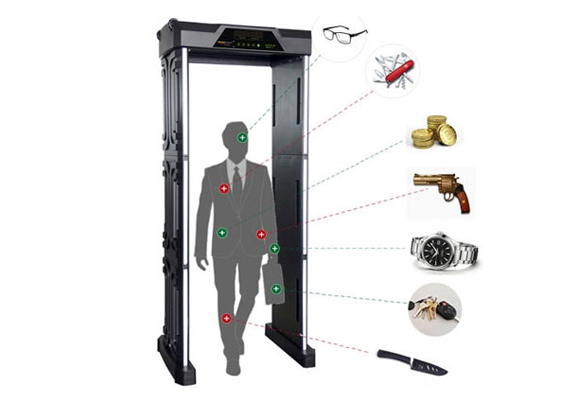
A metal detector is an electronic instrument which detects the presence of metal. Metal detectors are useful for finding metal hidden within objects, or metal objects buried underground. A Door Frame Metal Detector (DFMD) as the name suggests is a metal detector fitted in a door to detect metal that may be hidden on the body of the person passing through this door. This is also known as a “walk through” metal detector. These are used for security screening at access points in prisons, courthouses, and at airports to detect concealed metal weapons on a person’s body.
The simplest form of a metal detector consists of an oscillator producing an alternating current that passes through a coil producing an alternating magnetic field. If a piece of electrically conductive metal is close to the coil, eddy currents will be induced in the metal, and this produces a magnetic field of its own.
The biggest technical change in detectors was the development of the induction-balance system. This system involves two coils that are electrically balanced. When metal is introduced to their vicinity, they would become unbalanced. What allowed detectors to discriminate between metals was the fact that every metal has a different phase response when exposed to alternating current.